
I. This work of restructuring includes our beliefs and habits about money.
A. TRC Financial Restructuring underway.
1. The restructuring is underway at the corporate level as well. We have recently been restructuring our finances at TRC.
a. Added some new team members.
b. Developed a new budget.
2. This is one of the ways the Lord is preparing us for growth. He is increasing our financial intelligence and our understanding of biblical stewardship so that we can be ready for what’s to come. We will grow in the next season not just in numbers but in our reach as well. Restructuring is one of the ways God is preparing us for growth.
B. Concerning money & debt from session I.
1. Many of us have sold our future selves into debt service for a number of reasons. trying to maintain a lifestyle, trying to make ends meet, etc. But the Lord wants us to be free form debt service so that we can serve Him and enjoy a peaceful life with less financial stress.
2. The Holy Spirit will lead us out of debt if we obey His voice. (Through the Word and through His leading.) There will be a transition time, but He will provide all that we need. We do not have to fear the transition time if we are trusting in the Lord.
a. Debt is committing tomorrow’s income to yesterday’s decisions.
b. Financial freedom means getting your future back.
3. Psalm 66:10-12
10 For You, O God, have tested us; You have refined us as silver is refined. 11 You brought us into the net; You laid affliction on our backs. 12 You have caused men to ride over our heads; we went through fire and through water; but You brought us out to rich fulfillment.
C. Changing our relationship to money and debt. (Do something differently.)
1. In this session I want to talk about four shifts that we need to make in how we think about and manage our money. In how we see our income and our debt obligations. (If we want different results, then we need to do things differently.)
2. EX: I don’t work for my money, my money works for me. I don’t beg God for more money, I ask Him to release what He has already provide for me.
II. Four shifts to make in our thinking about money and debt.
A. First, renew your mind about money.
1. Rom 12:2
“And do not be conformed to this world, but be transformed by the renewing of your mind, that you may prove what is that good and acceptable and perfect will of God.”
2. Breakdown:
a. Do not be conformed: I will not think about money, handle my money or use my money the way the world does.
b. Renew the mind: I will learn to think about money the same way that God does.
c. Prove: My money habits will prove that God’s way is the right way.
3. The first and greatest battle we will ever fight is in our own mind. This is a battle over what we believe and it will decide how much we experience the life that God has for us.
a. We won’t be financially free if we keep thinking the same way that brought debt.
4. SHIFT: I am no longer focus on debt and limited resources, instead I am going to focus on God’s generosity and unlimited resources.
a. That is a shift from a Scarcity mindset to an Abundance mindset.
b. Scarcity focuses on what is lacking, Abundance focuses on what is possible.
5. Comparison table.
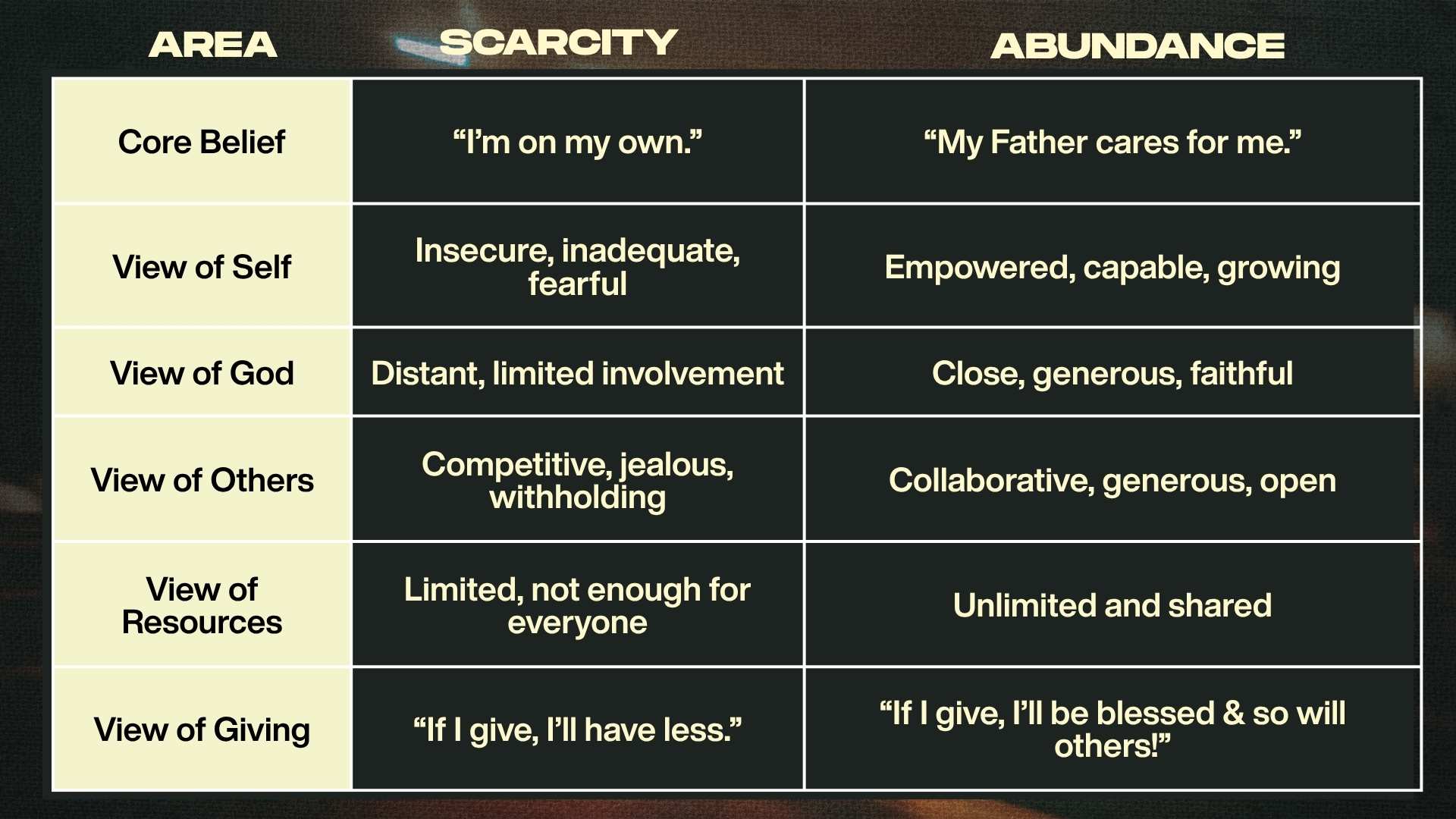
6. Just to be clear, an abundance mindset doesn’t pretend that you have money you don’t have. It means refusing to believe that your present resources define your future possibilities.
7. How are we going to renew our mind? By meditating on the Word. What we need is a thought transplant, mediating on God’s Word will do that.
8. Two scriptures:
a. Joshua 1:8
“This Book of the Law shall not depart from your mouth, but you shall meditate in it day and night, that you may observe to do according to all that is written in it. For then you will make your way prosperous, and then you will have good success.”
b. Psalm 1:1-3
1 Blessed is the man who walks not in the counsel of the ungodly, nor stands in the path of sinners, nor sits in the seat of the scornful; 2 But his delight is in the law of the Lord, and in His law he meditates day and night. 3 He shall be like a tree planted by the rivers of water, that brings forth its fruit in its season, whose leaf also shall not wither; and whatever he does shall prosper.
9. How do you meditate?
a. Both passages say day & night, start with a 15 min meditation AM & PM.
b. Get quiet, take one scripture and turn it over in your mind repeatedly.
c. Write it, speak it, change the emphasis, etc.
10. EX: 2 Cor 9:8 “And God is able to make all grace abound toward you, that you, always having all sufficiency in all things, may have an abundance for every good work.”
11. The FIRST SHIFT is to renew our mind by meditating on what God says about money.
a. Think of this as re-routing on a GPS.
b. You made some wrong turns, but trust the guide, you will get back on track.
c. Your finances may not change on Day 1, but your destination does.
12. Meditating on God’s Word feeds our spirit and makes it grow stronger. This is important because our flesh is what got us into debt but our spirit is going to lead us out.
B. Second, speak to the mountain.
1. Mark 11:22&24
22 So Jesus answered and said to them, “Have faith in God. 23 For assuredly, I say to you, whoever says to this mountain, ‘Be removed and be cast into the sea,’ and does not doubt in his heart, but believes that those things he says will be done, he will have whatever he says. 24 Therefore I say to you, whatever things you ask when you pray, believe that you receive them, and you will have them.
2. These are the instructions of Jesus, the Author and Perfector of our faith. Jesus says that mountains only move by faith and by confession. This is a spiritual principle.
a. Rom 10:9 “…confess with your mouth and believe in your heart…”
b. 2 Cor 4:13 “And since we have the same spirit of faith, according to what is written, “I believed and therefore I spoke,” we also believe and therefore speak…”
3. Jesus did not say “Whoever hopes that this mountain will be removed or whoever begs God for it to be removed.” He did not say whoever complains about the mountain…” He said “Whoever says to this mountain…” Whoever speaks to it.
4. Words are spirit containers. If you speak them in fear, they carry that fear into your world, if you speak them in faith, hope and love, then they carry faith, hope and love.
a. Faith doesn’t deny the mountain exists, it just refuses to give the mountain the final word.
5. The FIRST SHIFT is to renew our mind by meditating on God’s Word and the SECOND SHIFT is to say it out loud. Speak to the mountain.
a. Meditation changes the voice inside of you, confession changes the voice coming out of you.
6. What if it’s my own fault that I’m in debt? What if I made some bad choices and now I am being held captive to high interest debt?
a. Isa 61:1 “The Spirit of the Lord God is upon Me, because the Lord has anointed Me to preach good tidings to the poor; He has sent Me to heal the brokenhearted, to proclaim liberty to the captives, and the opening of the prison to those who are bound…”
b. 1 John 1:9 confess and repent and be washed clean.
c. Prov 9:1-6
“1 Wisdom has built her house, She has hewn out her seven pillars; 2 She has slaughtered her meat, She has mixed her wine, She has also furnished her table. 3 She has sent out her maidens, She cries out from the highest places of the city,
4 “Whoever is simple, let him turn in here!” As for him who lacks understanding, she says to him, 5 “Come, eat of my bread and drink of the wine I have mixed. 6 Forsake foolishness and live, and go in the way of understanding.”
7. NOTE: This is the same principle we need to obey to receive every promise. For healing, for restoration, for wisdom, etc. (MEDITATE > BELIEVE > SPEAK)
8. SOME PRACTICAL STEPS TO TAKE: Speaking to debt isn’t a substitute for confronting it and being a good steward.
a. Open the bills. Add up the balances. Know the interest rates.
b. Stop adding new debt. Make a plan.
c. Cut what needs to be cut. Sell what needs to be sold.
d. Increase income where you can. Then attack the debt.
C. Third, imitate the Lord’s generosity.
1. Luke 6:38
“Give, and it will be given to you: good measure, pressed down, shaken together, and running over will be put into your bosom. For with the same measure that you use, it will be measured back to you.”
2. 2 Cor 9:6 “But this I say: He who sows sparingly will also reap sparingly, and he who sows bountifully will also reap bountifully.”
3. We are created in God’s image. Jesus became one of us and showed us the Father, teaching us to follow His example. We are being transformed into the image of Christ. That means that the Spirit is working in us to make us like Jesus.
4. To become like Jesus, Who is just like God, we can study God’s attributes and integrate those same attributes into our lifestyle. Obviously we cannot become divine, so we cannot integrate omnipresence and omniscience! Those are attributes of God’s nature.
5. But think about the attributes of God’s character, the attributes of His personhood. God is a WHAT and a WHO at the same time. He is God and He is Father. And we are a WHAT and a WHO at the same time. I am a human and I am Jeff.
6. So if we think about the attributes of God’s person, Who God is, we can integrate those attributes into who we are and imitate Him.
a. God is not a liar, so we don’t lie.
b. God is merciful, so we will be merciful.
c. God is patient and long-suffering, so we will be patient and long-suffering.
d. God is also generous, so we will be generous. Generosity reveals Who God is.
7. When we are generous, we imitate our Father and become like Jesus.
a. Father is so generous He gave His only begotten Son to die sin our place.
b. Jesus is so generous that He gave His life for our sin, even though He is innocent.
c. The Spirit is so generous He fills us over and over again with all that God is; love, light wisdom, etc.
8. Generosity makes a statement that all we have comes form God and that we live by faith in Him. We don’t become generous when we become wealthy, we become generous when we become like Jesus.
9. Luke 16:9 “And I tell you, make friends for yourselves by means of unrighteous wealth, so that when it fails they may receive you into the eternal dwellings.”
a. Jesus is saying use your money for works that have eternal value.
b. Use money for good works and God’s kingdom & you will be welcomed by those you help for eternity.
c. You can’t take earthly money with you into eternity, but you can send it’s impact ahead of you.
III. The fourth shift: keep the covenant.
A. First three recap.
1. The first three shifts we need to make are:
a. Give yourself a thought transplant by meditating on scriptures about money, wealth and debt. (Feed your spirit so it can be stronger than your soul.)
b. Speak to the mountain.
c. Be generous just like your Father is generous.
2. Each of these deals with our thoughts, words and actions, the last one days with our heart.
B. The fourth shift is to tithe.
1. Tithing is not part of the Mosaic Law that was fulfilled by Jesus at Calvary. Tithing is part of the covenant of Abram, a covenant that we are included in.
2. There are only four types of giving mentioned in the bible.
a. The Tithe, Offerings, Alms and First Fruits giving.
b. The tithe comes first because (1) it affirms the covenant and (2) it tests our heart attitudes towards money.
3. Many people assume that NT Christians do not need to tithe because we are no longer under the Law of Moses. The Mosaic Law was fulfilled in Christ and no longer applies, but the tithe came before the Law and still applies to us today.
a. The tithe was established through God’s covenant with Abraham.
b. Rom 4:16 Abraham is the father of us all.
c. Gal 3:29 says that believers are Abraham’s children, and heirs of his covenant
4. Galatians 3:26-29
26 For you are all sons of God through faith in Christ Jesus. 27 For as many of you as were baptized into Christ have put on Christ. 28 There is neither Jew nor Greek, there is neither slave nor free, there is neither male nor female; for you are all one in Christ Jesus. 29 And if you are Christ’s, then you are Abraham’s seed, and heirs according to the promise.
5. Tithing is a covenant issue, not a legal issue or a contractual obligation. Our covenant is not based on the Law, but on faith. When we tithe, we affirm that we are in covenant with God through our faith in Him.
a. Remember the generation of Hebrews in the wilderness stopped keeping the covenant of circumcision?
b. Before they could defeat their enemies in Canaan and receive their inheritance God had Joshua circumcise all the males at Gilgal.
c. PRINCIPLE: There is no victory outside of the covenant. There is no inheritance outside of the covenant.
C. Where does the tithe go?
1. Malachi 3:10
“Bring all the tithes into the storehouse, that there may be food in My house, and try Me now in this,” Says the Lord of hosts, “If I will not open for you the windows of heaven and pour out for you such blessing that there will not be room enough to receive it.”
2. The storehouse is the local church.
a. The rule of thumb is: you tithe where you get fed and ministered to.
b. Another way of saying it is to tithe where you intend to reap.
c. I tithe here too, there are no exceptions.
d. Tithing is community building.
3. What if your finances are tight. Start somewhere and show Father the intention of your heart.
4. If you want to get out of debt and get your finances in order, start by following God’s financial order.
a. Tithe first your church home.
b. Offerings, alms and first fruits can go wherever else the Spirit leads.
5. Tithing makes a statement that says: ‘I am Abraham’s seed. I live by faith. I trust God’s covenant promises more than the economy, my paycheck, or my fears.’”
6. Tithing is not a bill that we owe God, it’s a declaration that we trust Him.
IV. Closing.
A. It is for freedom that Christ set us free.
1. Jesus died so that could be free from every bondage that weighs us down, including debt.
2. 2 Cor 8:9 “For you know the grace of our Lord Jesus Christ, that though he was rich, yet for your sake he became poor, so that you by his poverty might become rich.”
3. Start to take back your time and your life by making these four shifts.
a. THINK differently: Meditate on God’s Word
b. SPEAK differently: Speak to the mountain of debt.
c. LIVE differently: Be generous.
d. TRUST differently: Affirm the covenant by tithing.
4. If we want different financial results, we need different thoughts, different words, different habits, and ultimately a different object of trust.
B. Prayer and confession.