
I. Recap of Part X and Intro.
A. Rejecting the complexity of this world to live a simple life in Christ.
B. Today: simplifying community life by going back to the foundation. (Origin)
1. Today I want to talk with you about simplifying how we live and experience community life together. We need to renew our minds about who we are and how we are connected so that we can have a deeper revelation of where we belong and how we can serve one another.
2. The definition of community is a group of people living in the same place or a group of people connected by shared interests, religion, race or background.
a. Simply: a group of people who enjoy a sense of connection because of they share values and/or experience.
3. We are created to be social beings. Everyone wants community and looks for it in various ways. We want this connection so desperately that we change like chameleons just to try and fit in and find a sense of belonging.
4. The world looks for community and connection in race, social status, gender, sports teams, personal interests. We often find a level of connection over a shared interest, but the sense of belonging is only extended as long as you share that interest. If you move on or can’t participate any longer, the connection fades.
5. In the church, we mistake community for a denomination, or for an age group, for spiritual gifts and callings. We tend to think that we can only extend our fellowship to those who agree with us on everything, not just the essential doctrines, but even the non-essentials.
6. I have said for years “In the essentials, unity, in the non-essentials, liberty, in all things love.” And on the surface, most believers agree with that up until the point of conflict over a non-essential doctrine. (Things like speaking in tongues, deliverance, mediation on God’s Word, worship styles (flags), etc.)
C. A Family and a body.
1. We must understand that God has placed us in the most fundamental building block of human community— the family. When you’re born into a family, you don’t have to try and fit in, because you belong to the family based on your birth, not on your performance. (Even if the family rejects you, nothing can change the fact that biologically, you are part of that family by birth.)
2. God made us in His image and usually we only think about that in individualistic terms. “I” am created in God’s image instead of “We” are created in His image. God exists in community as Father, Son and Holy Spirit and we were created to live in community with Him and each other. We see unity in the Trinity. Harmony, acceptance and interdependence. And we are created to live with God and one another in this same cohesion.
3. We need to realize that as Christians, we have been connected to God and to one another. in the bond of family. We have already been placed in community by God when we confessed our faith in Jesus Christ as Savior and Lord.
a. We have a shared value— the love of God
b. We have a shared experience— salvation in Jesus Christ
4. This connection is not something we have done or something that we have created, it is something that God has created and He has placed us into.
a. We have beed adopted into His family.
b. Adoption occurs when a parent takes legal action, not the child.
5. WARNING: To reject the family that God has given us is rebellion. To refuse to accept and be accepted on the basis of divine family and instead try to find connection in any other way is
6. Anything else that we try to use a substitute for that family is a counterfeit to what God has provided for us.
II. Going back to the source.
A. Divine family is a more ancient foundation than denominations.
1. We need to go back to our foundations and remember that God has already given us connection and belonging by the blood of Jesus. (We’re going to go upstream to the source today.)
a. PICs of Nile delta and source.
2. We need to think beyond denominations and realize that before the birth of a single denomination, the church was one, and the church still is one. The early church saw themselves as the family of God.
3. I like to think of the denominations like the 12 tribes of Israel. They were all connected by race, and so are we, we are new creations in Christ. They were all connected by shared value, serving God, and so are we. They were all connected by a shared experience, deliverance from bondage, and so are we. The tribes were meant to serve one another and rally to each others defense, and I belie the denominations should function that way as well.
4. If we look at the traditional values of the main Protestant denominations, we see:
a. Anglican: sacred & historic continuity, ‘give me roots’
b. Presbyterian: truth and understanding the faith, ‘give me depth’
c. Methodist: grace expressed in life, ‘give me a faith that serves’
d. Wesleyan: transformed living, ‘give me a life that changes’
e. Baptist: evangelism and sharing the faith, ‘give me disciples’
f. Charismatic: encounter & expectancy, all things are possible, ‘give me an encounter with God’
5. These are all good things and valuable and we would benefit by learning these values form one another.
6. But these denominations are not our identity. If we go back upstream to the source, we will find that we are not Anglican, Presbyterian, Charismatic, etc., we are children of God.
B. Spirit birth precedes spiritual gifts and ministries.
1. The same is true for spiritual gifts. Many times we base our identity of of our gifts, what we are drawn to (bible study, prophetic experiences, serving, outreach, etc.). But there is One Spirit Who calls and empowers all of these things.
2. Before spiritual gifts, before the various ministries that we see in the NT, we first must be born of the Spirit. We can’t operate in a spiritual gift if we are not born of the Spirit.
3. Again, we need to top back to the source, to the beginning, the origins. Follow the flow of the Spirit back upstream, from the anointing on the gifts, form the calling and ministries all the way back to our adoption. First, we were born again by the Spirit, then led by the Spirit, the anointed by the Spirit.
4. Spiritual gifts and ministries were meant to serve the body by building up the saints, not exits in a vacuum for their own glorification.
C. Renewing our minds about Christian community.
1. Today I want us to ask the Lord to renew our minds about Christian community and see ourselves as belonging to the family of God and not just a church or a denomination.
2. We are going to revisit the roots of our community by remembering that before we are anything else, we are children of God.
3. We’re going to look at 1 John 2:12-14 and find ourselves adopted into the family of God.
III. Children, Fathers and Young Men.
A. Background & text.
1. The epistle is anonymous, but attributed to John the Beloved. He writes this letter to churches that had recently gone through a crisis of bad theology, which resulted in many breaking away from the church and stirring up division and dissension in the churches they left.
a.. No longer believed that Jesus was the Son of God nor Messiah.
b. Kept trying to sir up conflict and division even after they left.
2. This is why in chapter 1 John writes
a. Jesus is the Word of Life, came from the Father, the Son of God
b. We have seen Him and touched Him
c. We declare the gospel to you so that the fellowship that we have with God, you can have also.
d. Walk in the light as He is in the light and we will have fellowship with God.
3. In times of division and disagreement, remember that our fellowship is in Christ. If we continue to walk in His light, His revelation, we have fellowship with God and with one another.
4. 1 John 2:12-14
12 I write to you, little children, because your sins are forgiven you for His name’s sake. 13 I write to you, fathers, because you have known Him who is from the beginning. I write to you, young men, because you have overcome the wicked one. I write to you, little children, because you have known the Father. 14 I have written to you, fathers, because you have known Him who is from the beginning. I have written to you, young men, because you are strong, and the word of God abides in you, and you have overcome the wicked one.
5. John is describing three phases of life in our walk with the Lord. We can read this and identify the phase of life that we are currently in.
6. HOWEVER… all of these things are true for all believers in every phase. hey are true because Jesus finished the work of atoning for our sins by His blood on the cross.
a. If these are all true for all of us already, why does John address different life phases? Because we have other grow into the reality of these truths.
B. Table.
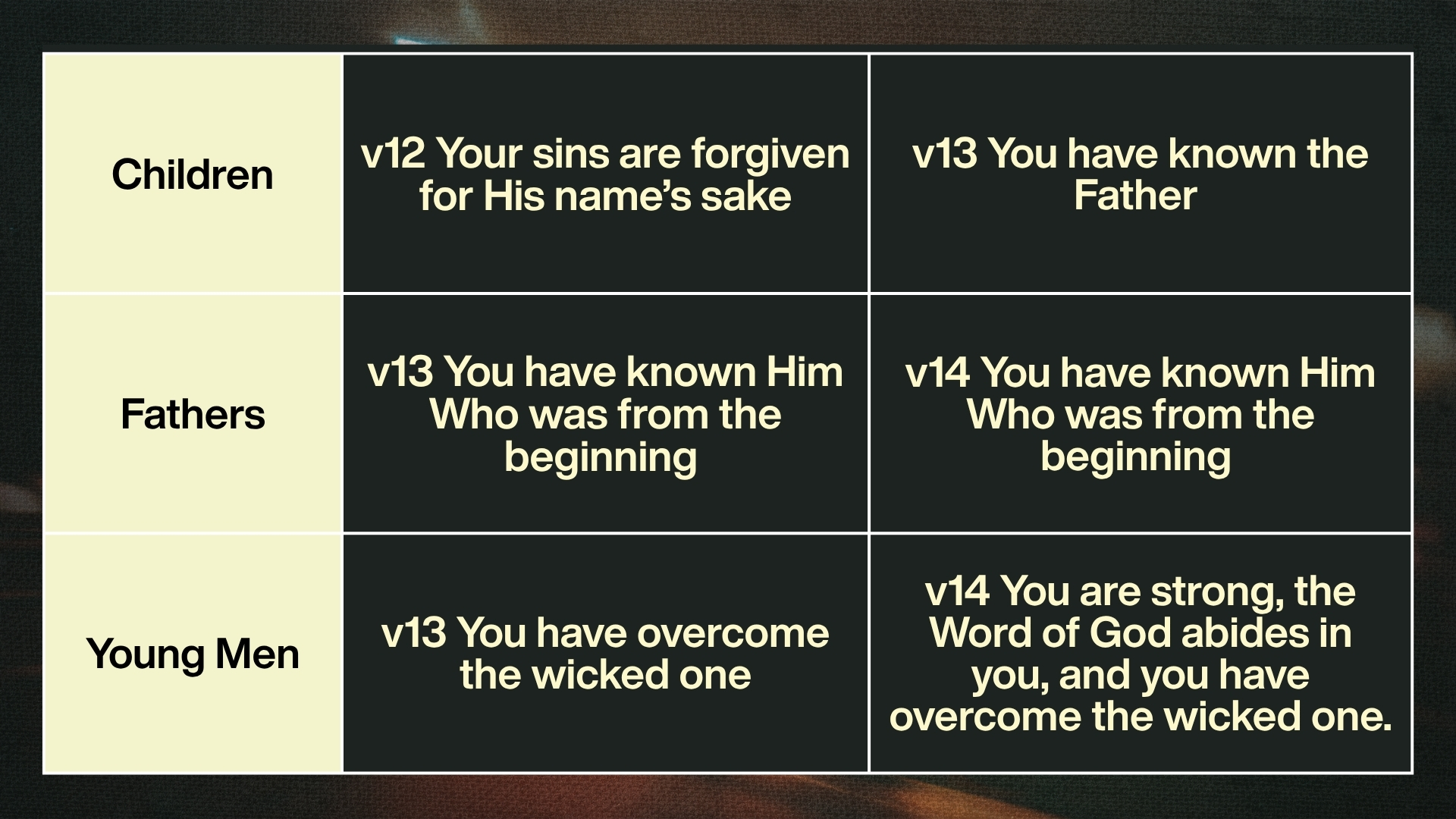
C. Children.
1. Not very human is a child of God, the bible does not teach that. Every human was created by God in His image, but not every human is a child of God.
a. John 1:12&13
12 But as many as received Him, to them He gave the right to become children of God, to those who believe in His name: 13 who were born, not of blood, nor of the will of the flesh, nor of the will of man, but of God.
b. Eph 2:3 Before confessing belief in Christ, we were children of wrath.
2. v 12 As a child of God, your sins ARE FORGIVEN for HIS name’s sake.
a. Past tense, are forgiven.
b. Jesus’ death on the cross paid for your sins by paying the debt forward.
c. Jesus offered Himself once and for all time for the sins the world.
d. Forgiven: aphiemi— sent away
e. He did this for His own sake, not for anything we have done.
3. v13 You have known the Father.
a. A child who knows their Father, not an orphan, in fellowship with God.
b. You have believed that Jesus is the Son of God Who died for your sin, now you have fellowship with God.
c. Ps 27:10 “Even if my mother and father forsake me, the Lord will take me up.”
4. Pastor Pratt’s testimony about losing his daughter. “She was never alone.”
5. The origin of our community is our adoption as sons and daughters into the family of God. Swim upstream, swim past the denominational division, swim past the error of seeing your calling or gift as your identity. Go all the way to the source and realize that our connection and fellowship is from God our Father. (Don’t doubt that your sins are forgiven or that you know God.)
6. Salvation.
D. Fathers.
1. To fathers, John writes the same thing twice, “You have known Him Who was from the beginning.” He also wrote this to the children.
2. We learn from this that knowing God is the foundation for our lives. Not just the knowledge of God, but intimacy with God and fellowship with Him.
3. We see that God is the Alpha & the Omega of our lives. There at the beginning when we were children right up until the end.
4. John doesn’t list accomplishments, he doesn’t list successes. At the end of our lives, the evidence of our faith is not going to be how much we accomplished for God but how well we knew Him.
5. EX: Paul wrote his letter to the Philippians whilst imprisoned in Rome, awaiting his martyrdom. (Written near the end of his life.)
a. In ch 1 he writes that he knows he is near the end of his life.
b. But in ch 3 he writes that anything that was a gain for him, any successes or accomplishments that he had in life, he considers nothing, rubbish
c. He considers them nothing compared to knowing Christ.
d. Vs 10&11
10 that I may know Him and the power of His resurrection, and the fellowship of His sufferings, being conformed to His death, 11 if, by any means, I may attain to the resurrection from the dead.
E. Young men.
1. Lastly, John writes to the ones in the middle. No longer children, but not yet fully mature.
2. In vs 13 he writes “You have overcome the evil one” and he repeats this in vs 14, where he adds “You are strong, the word of God abides in you…”
3. Just as the children need to remember that their sins ARE forgiven, the young adults in Christ need to remember that they HAVE overcome the evil one, they ARE over over comers. This phase of the Christian life is about learning to walk in and enforce the victory that Christ has won for us.
4. In 5:4&5 he writes:
“4 For whatever is born of God overcomes the world. And this is the victory that has overcome the world—our faith. 5 Who is he who overcomes the world, but he who believes that Jesus is the Son of God?
5. There are two parts to our overcoming the world; our birth into God’s family and our faith in Jesus, the Son of God.
a. Our position in the family is a gift and we just receive it.
b. But our part is to believe that Jesus is God’s Son and that on the cross, He redeemed us from sin, defeated death and triumphed over principalities and powers.
c. We overcome because of who we are and Who we believe in.
6. And John says “you ARE strong…” not you will be strong but now, you are strong. This is possible because Jesus is strong in us and for us. Even when we feel weak, His strength is made perfect in our weakness.
7. And His Word abides in us. As we mature in Christ, we learn how important it is to have His Word in us, to fill ourselves with it daily and to speak it in faith over our lives.
IV. Application and response.
A. Go back to the source of our fellowship and remember that we are family.
1. Before the denominations were formed, before we find our calling and discover our unique gifts, we are children in the family of God. By His own will, God has made us accepted in the beloved, counted as His own children. (Eph 1:6)
2. Here at TRC we need to embrace the reality of our family bond. (We have done well up to now, this is not a rebuke.) But we need to lean into this and consider one another as family and not as members of the same organization or institution.
a. Families get through hard times together without firing one of the children.
b. They don’t go through forced retirements or layoffs so that the rest of the family can maintain a standard of living.
c. A family bears one another’s burdens, defends one another, cares for one another.
3. If there are Christians that have offended you, forgive and release them. They are your brothers and sisters.
4. If there are Christians that you have broken fellowship with over a non-essential disagreement, reconcile to them. You don’t have to agree on non-essential doctrines, but you have to love them and be tender hearted to them.
B. Today we focus on receiving what God has already done.
1. How do we receive from God? By believing Him and thinking Him.
a. Receive His forgiveness today— you ARE forgiven.
b. Receive His friendship today— you HAVE KNOWN the Father.
c. Receive His strength today— you ARE strong.
d. Receive His Word today— it ABIDES in you.
e. Receive His victory over your enemies today— you HAVE OVERCOME the wicked one.
2. Refuse to believe the lie of your accuser that you do not belong, you do not fit in, that you are the black sheep, etc. You ARE accepted in the beloved.
C. Salvation.
1. If you are not yet part of God’s family, He calls to you today. “As many as believed Him, He gave the right to be children of God.”
2. If you have not received His grace and forgiveness, receive it today.
3. Believe in your heart and say with your mouth that Jesus Christ is Lord and that God has raised Him from the dead and you will be saved.