
I. Recap and Intro.
A. Rest comes before work.
1. God established a pattern for us to understand how we are to live. We see this pattern in the life of Adam and in how God delivered the Hebrews from Egypt.
2. The Pattern: God worked to prepare a place for them before they were even born. When God created them, they were born into God’s rest and enjoyed all the work that He had done on their behalf. Only after rest did they begin to do the works that God called them to.
3. The Christian life follows the same pattern.
4. In Ephesians 2 we find that we were dead in our sin when Christ was working out our salvation. God made us alive in Christ and raised us up with Him, sitting us down in heavenly places with Christ. This rest comes before we set out to do the works of Eph 2:10, the works that He has prepared for us that we should walk in them.
a. Light: the light of Christ that shines in our hearts
b. Time: the ages to come
c. Land: new heaven and new earth, Jesus is preparing a place for us
d. Purpose: works of righteousness
B. Hebrews 4 tells us about this rest.
1. It is a promise from God, not a duty. If we give God our anxiety, He will give us rest. 2. We must believe that God can handle our lives and let Him do it. We have stop trying to control everything if we have truly surrendered to God.
C. Today: Redeeming the Time.
1. Ephesians 5:15-17
15 See then that you walk circumspectly, not as fools but as wise, 16 redeeming the time, because the
days are evil. 17 Therefore do not be unwise, but understand what the will of the Lord is.
2. Col 4:5 “Walk in wisdom toward those who are outside, redeeming the time.”
3. Twice we are told that ability to manage our time reveals if we are foolish or wise. So that should motivate us to learn what God says about time and how we can redeem it.
D. THE WHY.
1. God created time for us and He cares about our time. God cares about our times of rest, fellowship, work and even exercise. God wants us to be free to serve Him and others and to enjoy life. He wants us to pursue work that is life giving and in alignment with our gifts and purpose.
a. In session I, God wants us free from the bondage of debt.
b. To buy back our future days that we have sold to lenders.
c. God is not condemning us, He just wants more for us.
d. This isn’t a reprimand, it’s a rescue.
2. There is something in the Word for all of us.
a. Young people: learn how to manage your time now.
b. Adults: learn to buy back your time and get free.
c. Seniors: learn how to maximize the time you have been given.
3. In this session:
a. What does it mean to redeem the time and how do we do that?
b. Two different types of time and how God created each one for us.
4. We’re not restructuring our lives so we can fit more into them. We’re restructuring our lives so we have room for what matters.
II. Two kinds of time: kairos and chronos.
A. Basic definitions.
1. Kairos: the right time, a critical moment, an opportune time, etc.
a. An appointed time, a time that has been set by the Lord for a specific purpose.
b. A God ordained turning point, a moment of opportunity not on the calendar.
c. Not about the duration of time, but what happens in that time.
d. The purpose of kairos is fruitfulness.
e. Ecc 3:11 He makes everything beautiful in time.
2. Chronos: chronological, chronology, etc.
a. Linear, march of time, the sequence of time, created by God for us.
b. Deadlines and due dates.
c. Can be measured on a watch, calendar, etc.
d. The purpose of chronos is productivity.
e. Ecc 11:6 “Sow your seed in the morning…”
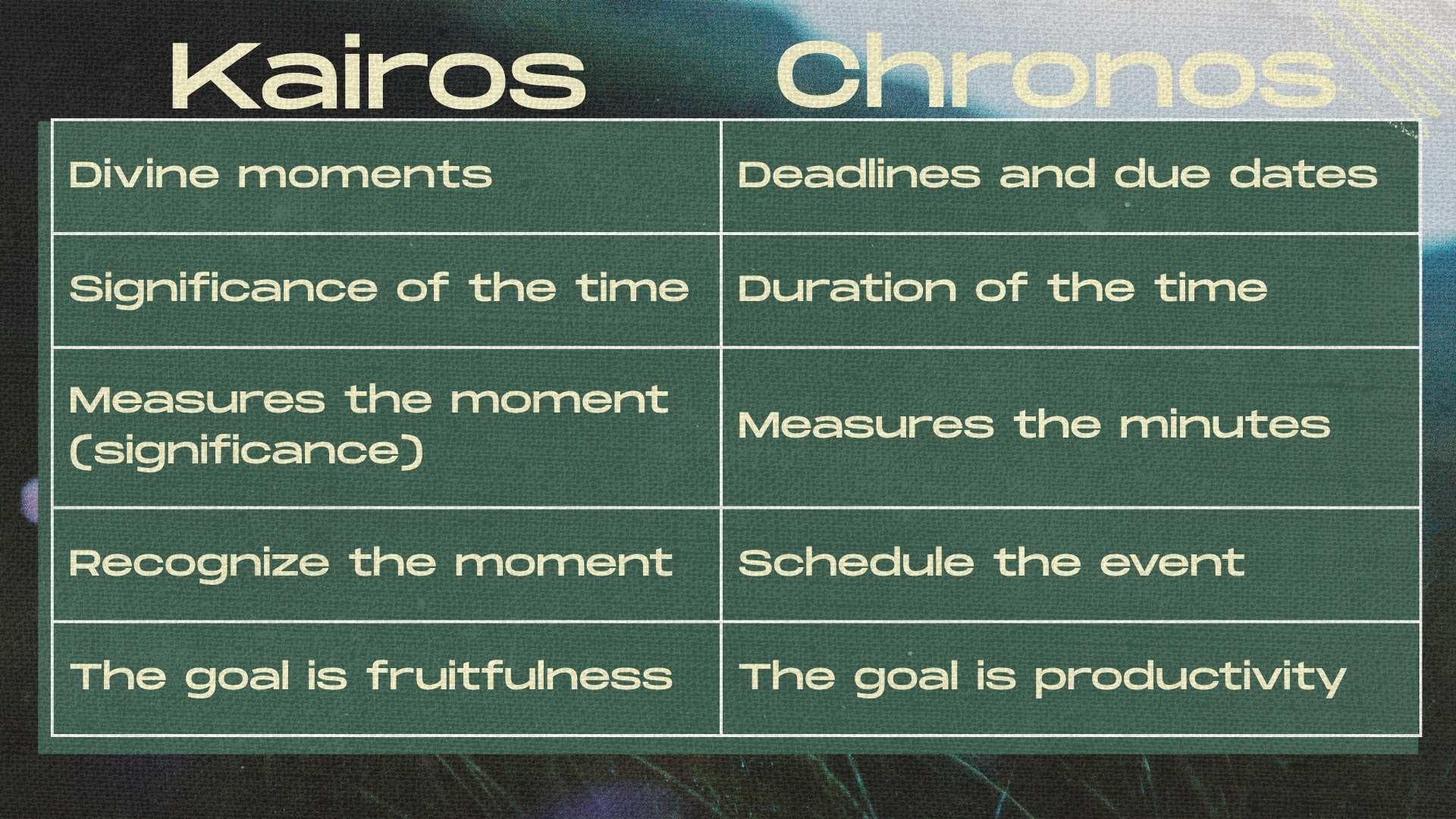
3. Further comparison of kairos and chronos:
a. Chronos asks “What time is it?”; Kairos asks “What is God doing in this time?”
b. Chronos tells you where you are on the calendar; Kairos tells you where you are in the purposes of God.
B. Fruitfulness vs productivity.
1. We need to stretch our thinking. We often think in terms of two sides… every issue is framed as black or white, Rep or Dem, Coke or Pepsi, Ford or Chevy, Toyota or Honda, etc. Reality is much more nuanced than that.
2. We are not choosing between kairos or chronos because we live in both. Instead we are learning to discern which to embrace as the Spirit leads, which one is appropriate for the moment.
a. Without kairos, chronos becomes a monotonous cycle.
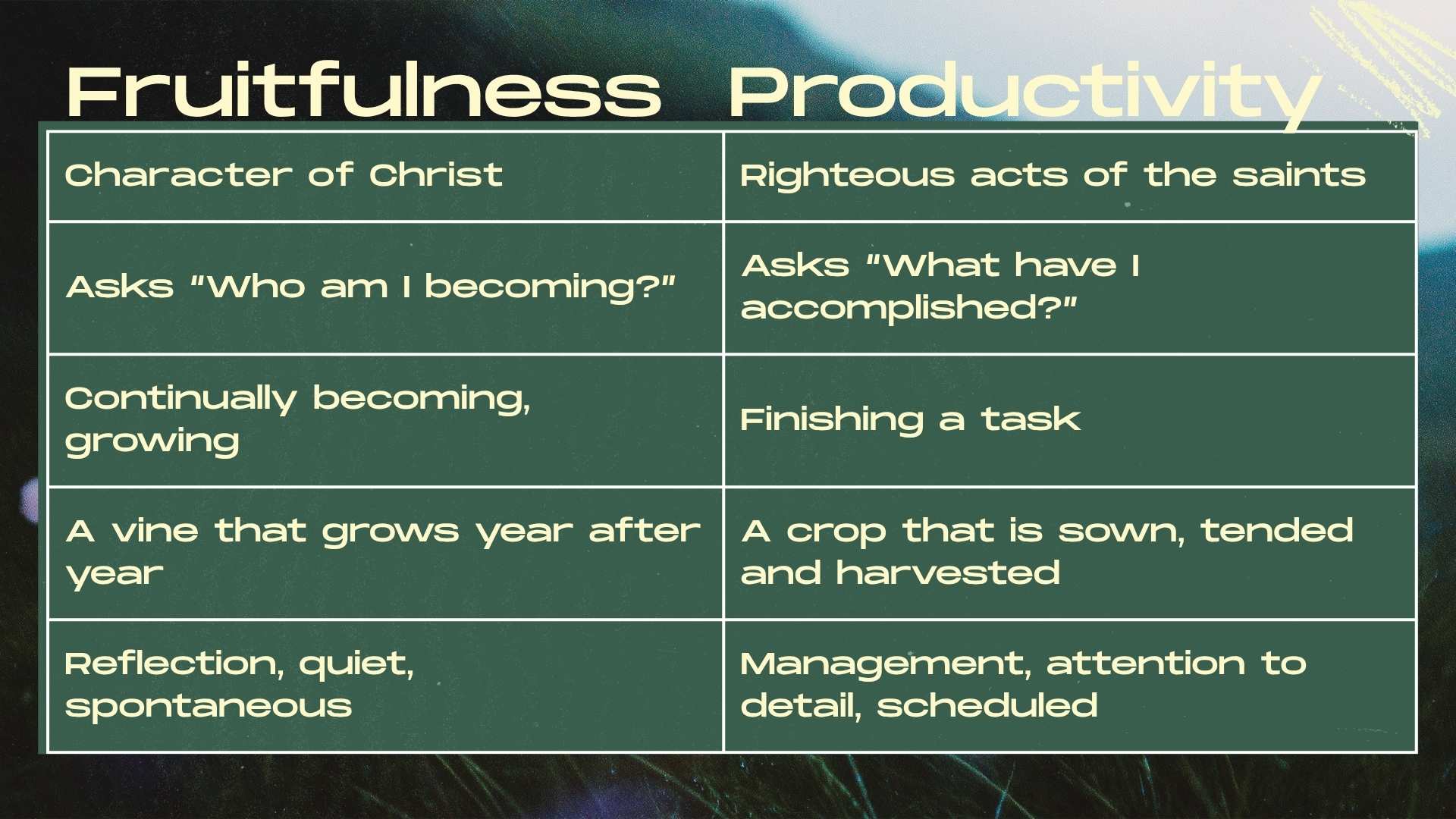
3. The problem is that we are so focused on productivity that we become bound to chronos, the calendar, schedules, etc. and we miss the divine moments when God desires to bring fruit out of us.
a. A full calendar does not necessarily mean a fulfilling life.
4. By God’s grace we can both fruitful and productive. Col 1:10 “…that you may walk worthy of the Lord, fully pleasing Him, being fruitful in every good work and increasing in the knowledge of God…”
5. Productivity is what comes from our hands, fruitfulness is about what comes from our life.
6. God cares about what we accomplish, but He is more concerned with who we are becoming whilst we accomplish it.
III. The first step in redeeming the time is discernment.(Wisdom is not joist knowing what to do, it is knowing what to do now.)
A. Luke 12:54-56
54 Then He also said to the multitudes, “Whenever you see a cloud rising out of the west, immediately you say, ‘A shower is coming’; and so it is. 55 And when you see the south wind blow, you say, ‘There will be hot weather’; and there is. 56 Hypocrites! You can discern the face of the sky and of the earth, but how is it you do not discern this time? (kairos)
1. Jesus is not saying to choose one or the other. He is not saying that we have to choose between interpreting natural signs or spiritual signs. He is saying that we need to understand both alike.
2. Why did he call them hypocrites? Doesn’t hypocrite mean ‘a pretender’?
a. hypocrite also means ‘an interpreter’
b. Calling them hypocrites is a play on words.
c. “You interpret the natural times and season but you cannot interpret the spiritual times and seasons, so you’re not a true interpreter, but a pretender.”
3. When Jesus says ‘how is it you do not discern this time?’ The word used for time there is is kairos, this divine moment.
4. Jesus is saying that we can know the date but not the season. Know the date on the calendar, but miss what God is doing at this time.
5. Jesus is teaching us that we should learn to recognize the divine moments of God the same way that we recognize the changing of the seasons and the time of year.
a. How do we recognize the change of seasons?
b. Cooler temps, earlier sunsets, leaves changing, etc.
c. How do we recognize divine moments?
d. Sensitivity to the Spirit, the sudden awareness of God in the moment.
B. EXAMPLE: Mary and Martha.
1. Luke 10:38-42
38 Now it happened as they went that He entered a certain village; and a certain woman named Martha welcomed Him into her house. 39 And she had a sister called Mary, who also sat at Jesus’ feet and heard His word. 40 But Martha was distracted with much serving, and she approached Him and said, “Lord, do You not care that my sister has left me to serve alone? Therefore tell her to help me.” 41 And Jesus answered and said to her, “Martha, Martha, you are worried and troubled about many things. 42 But one thing is needed, and Mary has chosen that good part, which will not be taken away from her.”
2. In this passage we see one person who was able to discern the difference between kairos
time and chronos time and one person who could not.
a. Which sister had good discernment? Mary or Martha?
b. Martha isn’t doing something sinful, she’s just doing the wrong thing at the wrong time.
c. It wasn’t that she was serving, the problem was that she didn’t recognize that time with Jesus was more important than serving.
3. Why was this a kairos time? Because Jesus came to their village and then their house for a completely unscheduled visit. This is the first time they are meeting Jesus.
4. Mary’s response:
a. She recognized that the significance of the moment, God is doing something right now, Jesus is speaking and touching my heart.
b. She sits at His feet and listens instead of serving the guests.
5. Martha’s response:
a. Completely missed the moment because she couldn’t discern the significance.
b. Focused instead on serving, which is productivity, effort, etc.
c. Vs 40 Martha was “…distracted with much serving.” This is what happens to us when we are task oriented, we get distracted and miss divine moments.
d. In her distraction, she complained to Jesus about Mary and insinuated that Jesus didn’t care about the work that had to be done.
6. The Lord’s response:
a. Tells Martha that she is worried and troubled about many things.
b. When we only focus on all that needs to get done, it never seems to get done.
c. “One thing is needed…” to meet with God when He comes to you.
d. When we choose to engage God in those moments, no pressure to be productive
or tyranny of urgent tasks will take that away from us.
7. Was Jesus saying that it’s wrong to serve? Not at all, He was saying know the time that you are in and act appropriately.
a. Is it time to meet with God or time to get other work?
b. Divine moments often come as interruptions in our schedule, we should embrace them anyway.
c. Busyness can distract us and make us miss what God is saying to us.
d. Martha saw an interruption, Mary saw an invitation.
IV. Step Two: Redeeming the time.
A. Redeem means to ‘buy back’.
1. Ephesians 5:15-17
15 See then that you walk circumspectly, not as fools but as wise, 16 redeeming the time, because the days are evil. 17 Therefore do not be unwise, but understand what the will of the Lord is.
2. Col 4:5 “Walk in wisdom toward those who are outside, redeeming the time.”
3. Redeeming the time means to take it back or buy it back. It means to keep it from being taken away by someone else. Something that is yours has been taken by someone else, so take it back.
4. As we saw with Mary and Martha, sometimes redeeming
B. Be active with your time, not passive.
1. To redeem our time we have to be active with our time, not passive. We have to actively manage our time and decide what we are going to do with it instead of just passively letting the demands of life and other people determine for us how our time will be spent.
a. Time is like money, if we don’t manage it, others will.
b. If we don’t decide what to do with it, others will.
2. Unredeemed time gets spent by default; redeemed time gets spent on purpose.
3. That shift in or minds is how it starts. If we can make that shift, it will change our lives because we will understand that debt is what gives others power over our time.
a. We will see that work and good stewardship is the means to take back our time.
b. Students: education is a means to control your future & not someone else.
3. We will see that actively pursuing kairos moments with the Lord will make us fruitful and productive. We find rest for our souls and grace for our work.
4. To actively manage our time we ask:
a. What is the best use of my time right now? Today? This weekend?
b. Is this opportunity from the Lord? If so, how do I make the most of it?
c. Even proactively scheduling rest and down time is redeeming the time.
C. Invite God into your time management.
1. Redeeming time isn’t ultimately about efficiency, it’s about aligning our time with the will of God.
2. Ask the Lord to make you fruitful and to establish the work of your hands. We do not have to choose between one or the other, so ask for both. “Make me always abounding with the fruit of the Spirit and always prospering in the work of my hands.”
3. A clock can tell you what time it is, but only discernment can tell you what the time is for. Ask the Lord “What is this time for?”
D. If we do this, we fulfill the command of Ephesians 5:15-17
15 See then that you walk circumspectly, not as fools but as wise, 16 redeeming the time, because the days are evil. 17 Therefore do not be unwise, but understand what the will of the Lord is.
1. Walk in wisdom, redeem the time, understand the will of the Lord.
2. Prayer:
Father, teach me to recognize the moments You have given me. Teach me when to work and when to rest. Teach me when to move and when to wait. Teach me to be productive with my hands without becoming barren in my soul. Make my life fruitful, and establish the work of my hands.