
I. Intro.
A. Early this year I saw that the Lord would undertake a work of restructuring in 2026 and
beyond.
1. This is a multi-year work and it will transform the Christian lifestyle in the West.
2. This is not…
a. rebuilding: that implies reconstructing a building that has been destroyed
b. remodeling: that implies putting a new face on an existing structure, surface level
c. This is a work of restructuring.
3 Definition: the act of reorganizing a company’s or a group’s financial and organizational structures and systems to adapt to changes, address challenges and improve efficiency.
4. Spiritually: Significant changes to the way Christians think, live and speak that are necessary to adapt to the changing world system, address the challenges that we face and improve our efforts to make disciples.
5. NOTE: At no point did I sense that the Lord is angry with His people and I do not believe His restructuring is punishment. It is correction and will require discipline but He is doing this for our good.
6. God’s restructuring is not a reprimand, it’s a rescue.
B. Dream of the false pillars in the church.
1. I received this dream in February of this year.
a. Massive ancient structure built on top of an even older foundation.
b. My friend took a large sledgehammer and knocked out two false pillars.
c. The roof went higher- it was being held down by the false pillars.
d. A false wall fell away and we realized it had been blocking our vision.
2. The false supports and false wall are structures that people have added to God’s building. Things we have added to the church that are not part of God’s design. They are false support, we don’t need them but we have faith in them, and a false wall that keeps the world outside and keeps our vision limited to inside the walls.
3. The Sledgehammer is the Word. (Jer 23:29) When the Word is applied to our extra biblical structures, they cannot stand.
C. The key areas of restructuring that I currently see are financial, time management and family dynamics. (This will overflow into Church life.)
1. Financial: our attitudes, habits and emotions concerning money & lifestyle. (Hint: the Word of God should influence our lifestyle, not American culture.)
a. God is tired of us serving debt with little time or money left to serve Him.
2. Time Management: the tendency to surrender our time to Chronos instead of being led by the Spirit into the Kairos times and seasons of God.
a. The Lord would have us change our focus from productivity to fruitfulness.
3. Family Dynamics: the Lord would remind us that family is His idea and His creation, that children are not a burden and we should stop outsourcing their discipline and development.
a. The irony is that we all love freedom but many of us are playing into the hands of big government by allowing the state to raise them and culture to influence them.
4. All three of these areas are interrelated. Our financial habits lead to debt, which steals our time and minimizes our ability to train our children in the ways of the Lord.
II. Key Concepts.
A. What the Lord wants to lead us into is new to some of us but ancient wisdom to Him.
1. I’m not talking about some new, extra biblical revelation. I’m talking about a deeper integration of the Word of God into our thinking and daily living.
2. Jeremiah 6:16
“Thus says the Lord: “Stand in the ways and see, and ask for the old paths, where the good way is, and walk in it; then you will find rest for your souls. But they said, ‘We will not walk in it.’”
3. All throughout the scriptures, God had to periodically restructure the thoughts and lives of His people. This is a normal and healthy process for God’s people.
4. Jeremiah 1:9&10
9 Then the Lord put forth His hand and touched my mouth, and the Lord said to me: “Behold, I have put My words in your mouth.
10 See, I have this day set you over the nations and over the kingdoms, to root out and to pull down, to destroy and to throw down, to build and to plant.”
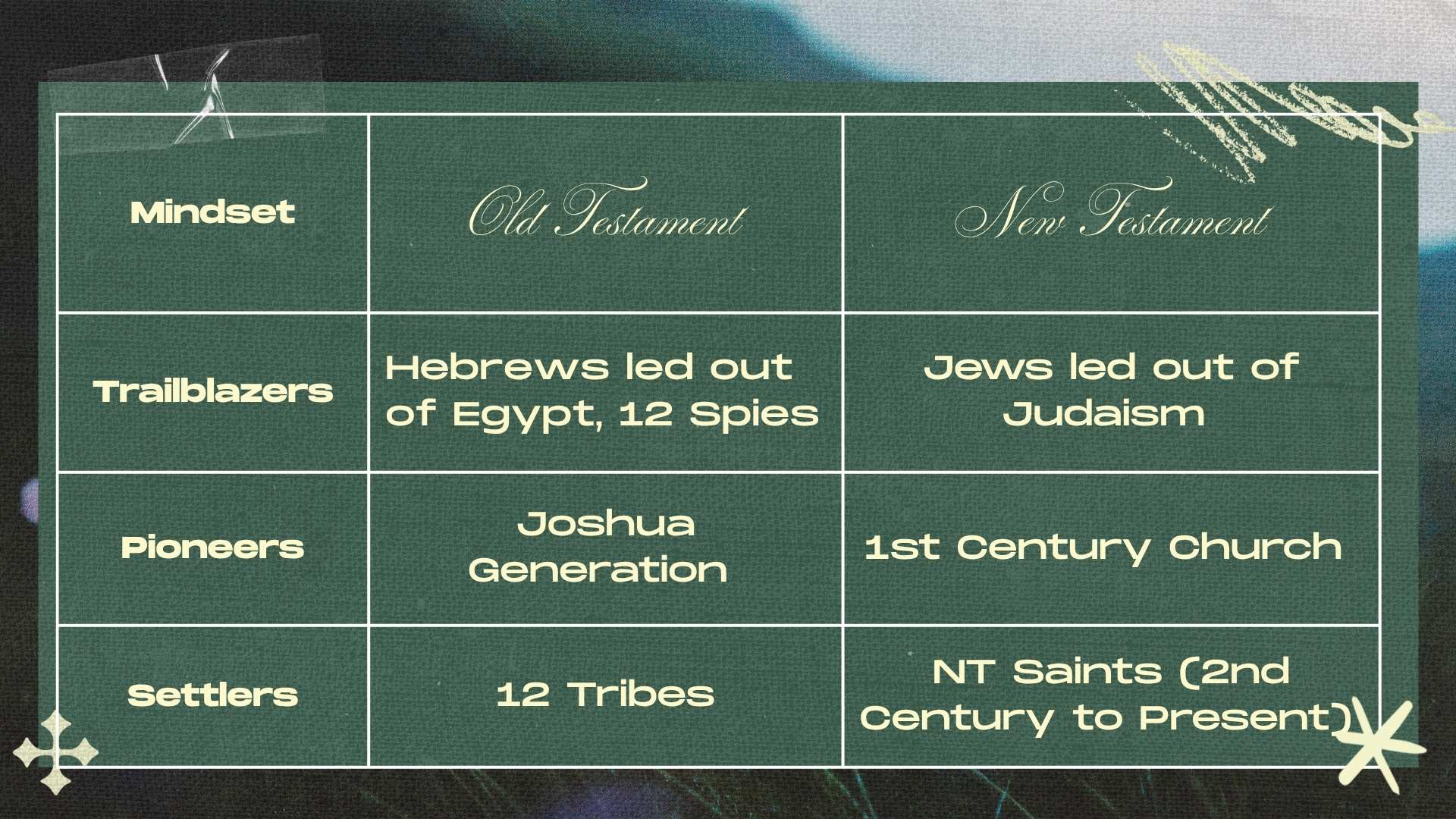
B. Trailblazers, Pioneers and Settlers.
1. There is a helpful business and institutional concept that puts people into three categories based on their willingness to adapt to change.
a. Trailblazers: take massive risks, break barriers, chart new territory
b. Pioneers: step into the newly charted territory and face the rugged challenges, they adapt to live in the new territory and build
c. Settlers: feel safe enough to live in this new territory, add their skills and build community
2. Here is what this looks like when applied to God’s people.
3. Here is what this looks like when applied to us.
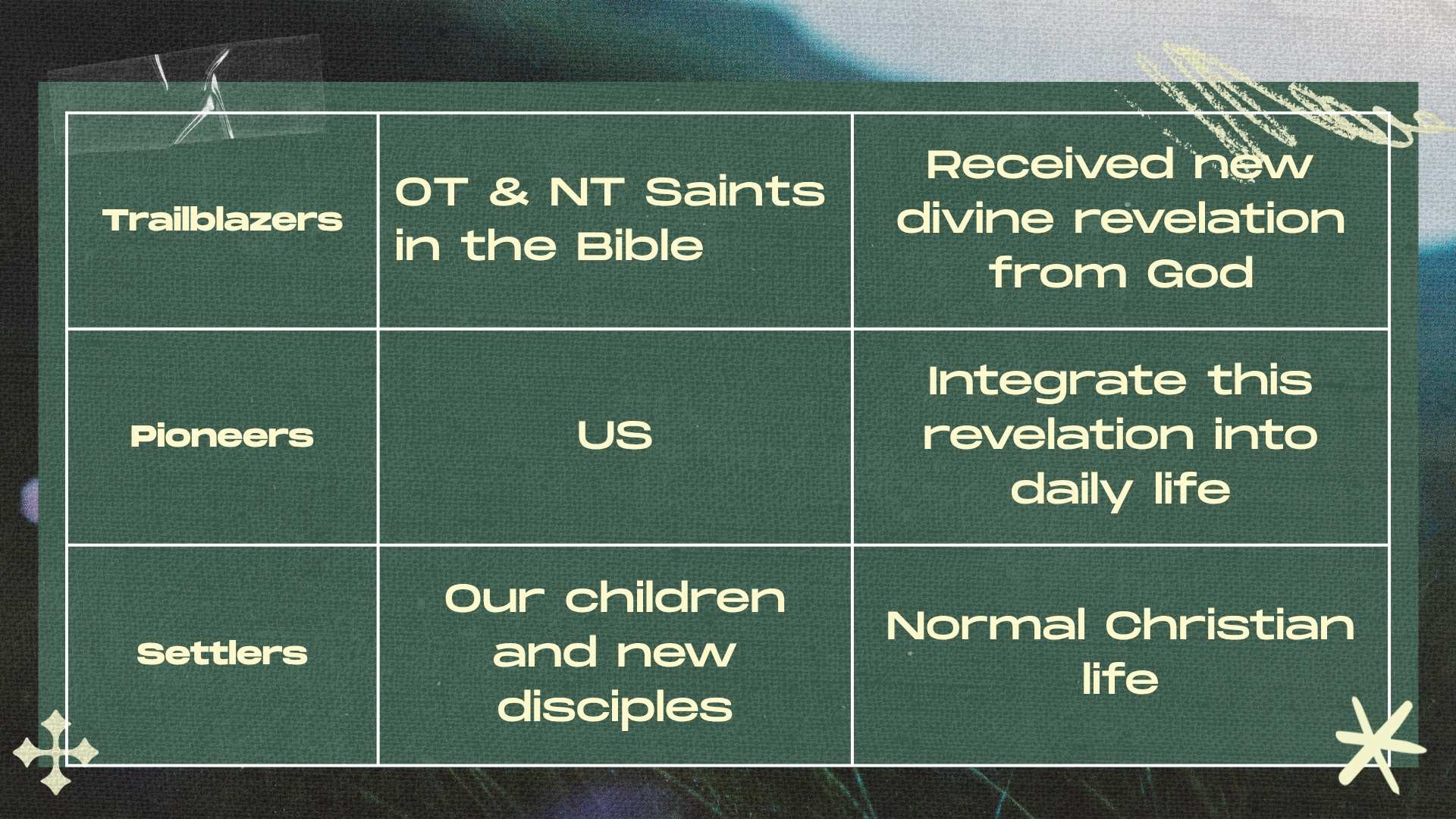
4. We may all be at different phases of the journey. Maybe you are the first to become a disciple in your family, maybe your parents and grandparents were saved. The point is that future generations of the church are depending on us to integrate the Word of God into our daily lives so that it becomes normal for them.
C. I will use the Biblical comparison of Egypt and Zion to refer to the culture of the world vs
the culture of heaven.
1. 1 Cor 10:1-13 Recounts some of the major errors of God’s people in the wilderness after their deliverance from Egypt. Vs 11 says “Now all these things happened to them as examples, and they were written for our admonition, upon whom the ends of the ages have come.”
2. Vs 12:13
12 Therefore let him who thinks he stands take heed lest he fall. 13 No temptation has overtaken you except such as is common to man; but God is faithful, who will not allow you to be tempted beyond what you are able, but with the temptation will also make the way of escape, that you may be able to bear it.
a. In other words, don’t get cocky and think you won’t fall to the same temptations that the Hebrews in the wilderness did.
b. We need to read and understand from their mistakes and apply those lessons to our lives.
c. These are the trailblazers.
3. Throughout this series, I will use Egypt and Zion to refer to the world system and culture and the culture of God’s kingdom. (Egypt = the world; Zion = God’s kingdom)
III. He got us out of Egypt, but He has to get Egypt out of us.
A. A crucial lesson from the generation that was delivered from Egypt.
1. The Lord delivered His people from slavery in Egypt because they cried out to Him.
a. Exodus 3:7, 9
7 And the Lord said: “I have surely seen the oppression of My people who are in Egypt, and have heard their cry because of their taskmasters, for I know their sorrows.
9 Now therefore, behold, the cry of the children of Israel has come to Me, and I have also seen the oppression with which the Egyptians oppress them.
2. But after they were set free, they expressed a desire to go back into slavery because their souls craved the delicacies of Egypt.
a. Num 14:4; Ex 14:12; Ex 16:3 (craved the meat and bread of Egypt)
B. We are faced with the same temptation and we often fall to it.
1. Anyone who has ever had a soul crushing job knows the bondage of spiritual Egypt. You would think that we would all be doing the Dave Ramsey approach to get free from it.
2. But after a while, our souls crave the delicacies and the luxuries of Egypt. We want to go back under bondage so we can enjoy the stuff.
a. So we sell ourselves into debt service so that we can enjoy Egypt.
b. Credit used to be called ‘buying on time’ (pay it off over time)
c. But we’ve actually put our future into bondage called debt service so that we can indulge the craving of our soul in the present.
3. Work is not bondage, debt is. Your job is not holding you back, your debt is.
C. The Lord will lead us out if we follow Him.
1. The Lord would rather have us live free in a tent than live in bondage in Egypt. he will lead us out if we follow Him.
2. There will be a transition time, but He will provide all that we need. We do not have to fear the transition time, the restructuring time, if we follow the Spirit’s leading.
3. Psalm 66:10-12
10 For You, O God, have tested us; You have refined us as silver is refined. 11 You brought us into the net; You laid affliction on our backs. 12 You have caused men to ride over our heads; we went through fire and through water; but You brought us out to rich fulfillment.
4. The question is, are we willing to follow the Lord into the revelation that He has already given? Are we going to be pioneers by integrating what God has revealed in His Word into our thinking and living?
IV. Where do we start? By renewing our minds.
A. #1: Renewing the mind.
1. Romans 12:1&2
1 I beseech you therefore, brethren, by the mercies of God, that you present your bodies a living sacrifice, holy, acceptable to God, which is your reasonable service. 2 And do not be conformed to this world, but be transformed by the renewing of your mind, that you may prove what is that good and acceptable and perfect will of God.
2. Our lives should prove that God’s wisdom is greater than the wisdom of Egypt.
3. Transformation is a process, and we have other be committed to the process. We have to do the work.
4. Ephesians 5:25-27
25 Husbands, love your wives, just as Christ also loved the church and gave Himself for her, 26 that He might sanctify and cleanse her with the washing of water by the word, 27 that He might present her to Himself a glorious church, not having spot or wrinkle or any such thing, but that she should be holy and without blemish.”
5. What does it mean to wash our mind in the Word?
B. #2: We have to break agreement with Egypt.
1. 2 Corinthians 6:17&18
17 Therefore “Come out from among them and be separate, says the Lord. Do not touch what is unclean, and I will receive you.” 18 “I will be a Father to you, and you shall be My sons and daughters,” says the Lord Almighty.”
2. We have other consecrate ourselves to the Lord.
C. Action steps.